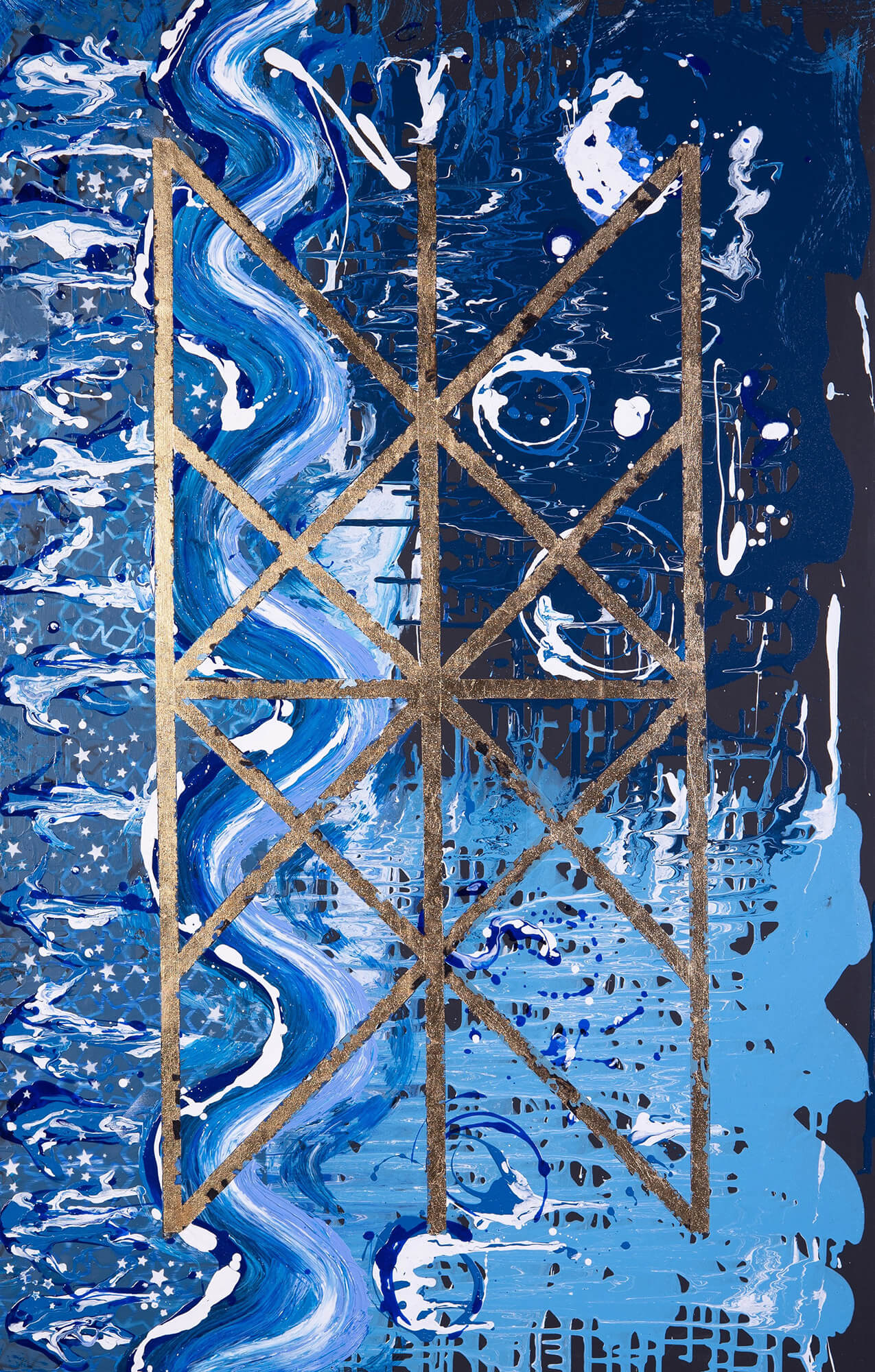
This object began as a single canvas. Before painting, I drew a grid of squares inspired by the Fibonacci sequence, the proportion that, through quarter-circles, draws the golden spiral. Nature only approximates this order, in shells, seed heads and branching growth, but it returns again and again, at every scale. I used it as a hidden structure, a quiet skeleton under the paint.
Over it I built the painting in layers, one flowing gesture upon another, in different pigments. Slowly the gestures gathered into a single wave, a harmony that holds together. The marks can be read in two ways. They may be the inside of the brain at micro scale, the soft, cloud-like tissue of the brain and the fluid that flows through it. Or they may be the deep sea, with currents, filaments and drifting life. The two images resemble each other because both are living, watery networks, and both hold the same quality: the deeper you go, the stiller it becomes.
I then cut the canvas apart. Metal eyelets set into each fragment let me stretch the pieces into an aluminium frame, sewn through with leather and polyester ropes. The ropes are my own thoughts and ideas, crossing without order. It is always difficult for me to clear my mind, so I try to organise it, and this object is where I make that attempt. It is easy to get lost among them.
The gaps between the fragments stand for Turiya, the fourth state of mind in Indian philosophy, beyond waking, dreaming and deep sleep. It is an empty space where something new can arrive. Looking through the tangle toward the still blue depth is the same journey as quieting the mind.
Within Hopium, the object offers a small resistance to constant information. Hope may begin by leaving room for nothing.
About the music: “Dream Within a Dream” builds slowly toward stillness, like the ropes giving way to the calm behind them.
Music: